
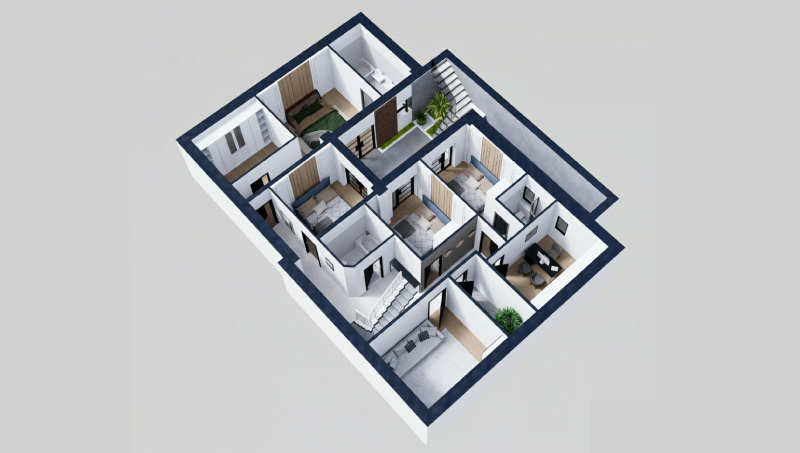
Floor Plan
A floor plan is a scaled diagram that shows the layout of rooms, spaces, walls, doors, windows, and circulation paths in a building. It is one of the most essential components of architectural design because it visually explains how a space will function, how people will move within it, and how different rooms connect to each other.
Floor plans act as a blueprint of your vision, allowing architects, builders, and homeowners to make clear decisions long before construction begins.
Why Floor Plans Are Important
1. Helps Visualize the Space
A floor plan gives a clear understanding of room sizes, layout, flow, and how furniture or equipment will fit inside the building.
2. Prevents Costly Mistakes
By planning everything in advance—room placement, doors, windows, utilities—floor plans reduce structural errors and redesign costs.
3. Improves Functionality
A well-designed floor plan ensures proper ventilation, natural lighting, smooth circulation, and a practical room arrangement.
4. Essential for Construction & Permissions
Contractors, engineers, and municipal authorities rely on accurate floor plans for building approvals and successful project execution.
5. Better Communication With Clients
Clients can easily understand the design, make decisions, and visualize how the space will look and feel.
Types of Floor Plans
1. 2D Floor Plan
A flat drawing showing walls, openings, dimensions, and labels.
Useful for technical understanding and measurement accuracy.
2. 3D Floor Plan
A more realistic and visual version where walls, textures, furniture, and materials are shown in 3D form.
3. Furniture Layout Plan
Shows furniture placement, circulation paths, and interior planning.
4. Electrical Layout Plan
Displays wiring, switches, lights, sockets, and appliances.
5. Plumbing Layout Plan
Indicates water lines, drainage, sanitary fittings, and plumbing networks.
6. Structural Floor Plan
Shows beams, columns, slab thickness, and reinforcement details.
What a Good Floor Plan Should Include
A perfect floor plan typically contains:
- Room dimensions & labels
- Wall thickness
- Door and window positions
- Furniture layout
- Staircase placement
- Circulation space
- Ventilation & lighting flow
- Washroom & kitchen connection
- Utility areas
- Entry/exit points
- Orientation (North direction)
These elements ensure functionality, comfort, and efficient space usage.
Benefits of a Professional Floor Plan
- Better project planning
- Accurate estimation of construction cost
- Smooth communication between architect & client
- Optimized room layout and space saving
- Enhanced natural lighting & ventilation
- Faster design revision and improvements
- Increases property value
- Reduces overall construction time
How Architects Create Floor Plans (Step-by-Step)
1. Requirement Analysis
Understanding client needs, lifestyle, number of rooms, budget, and land size.
2. Site Measurement & Study
Evaluating land orientation, road access, sun position, and surroundings.
3. Conceptual Sketching
Basic hand-drawn or digital rough sketches.
4. Detailed Floor Plan Drafting
Complete 2D drawings with accurate dimensions and labels.
5. Review & Modifications
Client feedback is applied to refine the layout.
6. Final Plan Delivery
The final approved plan includes all technical and architectural details.
Conclusion
A floor plan is the foundation of every architectural design. It shapes the layout, functionality, and beauty of a structure long before construction begins. Whether it’s a home, office, commercial building, or interior renovation project, a well-designed floor plan saves time, money, and future frustration.
Choosing a professional architectural team ensures that your space is optimized, efficient, and perfectly aligned with your lifestyle and vision.
Ready to order your project ?
Subscribe
Want to be notified about our News. Just sign up and we'll send you a notification by email.